Practical guide
Canceling Shared Plans: Clear Messages and Rescheduling Examples
Name the original plan, state the cancellation clearly and acknowledge the practical impact you know. Offer only a feasible alternative, distinguish a scheduling update from a meeting, and confirm what was actually accepted.
Say what is cancelled, then give the next practical step
A clear cancellation message names the shared plan, says you cannot attend or continue with it, acknowledges the change and explains the next practical step. Send it when you know the change, when it is safe and possible, rather than waiting for a perfect explanation. A rescheduling option is useful only if you can realistically offer it.
For example: “I can’t make our dinner at 7 tonight. I’m sorry to change the plan after you set the evening aside. Please don’t travel to the restaurant for me. I can offer Saturday lunch if you still want to meet; would that work?” The time and alternative are fictional examples, not a required notice period or a formula for a good reaction.
Separate three questions: what is happening to the original plan, what needs changing now, and whether you want to propose another plan. “Maybe another time” may communicate warmth, but it does not schedule anything. “I might be late” does not clearly cancel an evening you already know you cannot attend.
This guide is for ordinary voluntary plans with partners, friends or relatives. It does not make another person accept a cancellation, resolve a relationship pattern or determine what is safe. Essential care, emergencies and contractual arrangements need their actual support plans or terms; cancelling a social activity is not a model for leaving someone without necessary care.
Match the notice to what the other person needs to change
Think about what the other person may already have committed: travel, preparation, a booking or time away from something else. Name the impact you actually know. “You already left home” is more specific than “Sorry for everything.” Avoid inventing their feelings, costs or motives; ask about an unknown practical consequence where it matters.
| Situation | State clearly | Immediate practical check | Keep the limit visible |
|---|---|---|---|
| Several days before | Which activity or date you cannot keep. | Can preparation or a shared booking be changed? | Earlier notice does not erase every inconvenience. |
| On the same day | Whether the plan is cancelled, not merely delayed. | Does anyone need to stop travelling or preparing? | A message sent is not necessarily a message received. |
| They are already travelling | That you cannot meet and what happens to the original location. | Use an appropriate usual channel to make the change clear. | Do not demand unsafe phone use or a reply while driving. |
| Another date is uncertain | That there is no replacement date yet. | Is a later scheduling update something you can offer? | An update promise is not a meeting appointment. |
| You do not want to reschedule | The original plan is off and you are not offering a replacement. | Clarify any remaining shared practical arrangement. | Do not invent a future invitation to soften the message. |
Choose a channel that fits the urgency and your normal communication. For a plan still days away, the usual message thread may be enough. For someone possibly about to travel, a brief call or another normally used channel may help them notice the change, when appropriate and safe. This is not permission to keep calling, bypass a stated no-contact limit or demand a response.
Do not wait for a reply to state the cancellation clearly. Equally, do not assume a silent person has seen it. Where immediate logistics matter, focus a proportionate follow-up on receipt and the practical change, rather than sending a stream of apologies or accusations.
If there is a booking, check the real booking terms and agreed responsibilities. Say what you have actually done: “I have asked the venue whether the reservation can be changed” is different from “It is refunded.” This guide cannot establish who owes a fee, whether a refund is available or whether an existing obligation disappears.
Six cancellation messages and realistic follow-ups
These six message, possible-reply and follow-up sequences are original fictional examples. They illustrate different next steps, not reactions you can require. Adapt them to the actual plan, your voice and the other person’s stated limits.
1. Several days ahead: offer an option you have checked
Notice: “I can’t keep our Sunday walk. I’m sorry to change a plan we both set aside. Would Saturday morning work instead? If not, we can leave another date open.”
Possible reply: “Saturday does not work for me. Let’s leave it for now.”
Follow-up: “Understood. Sunday is cancelled, and we have no new date agreed.”
The sender names the cancelled plan and offers a feasible option without treating it as accepted. The reply declines the alternative; the close records the actual outcome.
2. Same-day cancellation: acknowledge the preparation
Notice: “I can’t come to dinner tonight. I’m sorry for the short notice, especially since you have started preparing. Please go ahead without me. Can we check what practical arrangements still need changing?”
Possible reply: “I have already bought food, and I’m disappointed.”
Follow-up: “I understand the change has affected your evening. I won’t ask you to be okay with it immediately. Let’s clarify the food or booking arrangements rather than assume they are solved.”
The impact is concrete. There is no invented fee, refund or obligation in the example, and an apology is not used to demand a cheerful response.
3. They are already on the way: make the original plan unambiguous
Notice: “I can’t meet at the café today. I’m sorry to change this after you left. We are not meeting there as planned. Please read or reply only when it is safe; I don’t want you using your phone while driving.”
Possible reply: “I’ve stopped and seen this. I’ll make another plan for the afternoon.”
Follow-up: “Thank you for confirming you saw it. We can discuss any remaining arrangements later if needed.”
Receipt matters here, but safety matters too. The message does not announce a new location, promise a replacement meeting or pressure the recipient to respond while travelling.
4. No replacement date yet: promise only the scheduling step
Notice: “I need to cancel our call tomorrow. I don’t know my availability for another call yet. I can send you an update on Friday about possible dates, if you still want one.”
Possible reply: “An update is fine, but please don’t call Friday without agreeing a time.”
Follow-up: “Agreed: a scheduling message on Friday, not a call appointment.”
The limited commitment is explicit. The sender should offer this only if the update is realistic; it does not imply that a replacement call has been accepted.
5. You are not offering another meeting
Notice: “I can’t keep our planned visit, and I’m not offering another date. I wanted to tell you clearly rather than leave you waiting for a new invitation. Let’s clarify any remaining practical arrangements.”
Possible reply: “I’m disappointed, but I understand there is no new date.”
Follow-up: “Yes. I won’t describe this as rescheduled.”
Do not propose a date you do not want or cannot keep merely to make a refusal sound softer. A clear limit and a voluntary response can coexist without a long personal justification.
6. Repair after your preventable scheduling mistake
Notice: “I agreed to two things at the same time and have to cancel our outing. That was my scheduling mistake. I’m sorry for the disruption. I will check my calendar before agreeing next time. I can offer Tuesday evening, but I understand if you don’t want to rearrange.”
Possible reply: “I want to see the change before making another plan.”
Follow-up: “That’s fair. I’ll follow through on the calendar check and won’t keep asking you to reassure me.”
The changed behavior is specific and within the sender’s control. A practical offer is separate from accountability; the other person can decline rescheduling or need more time.
Reschedule by agreement, not by replacing the date yourself
“Would Tuesday at 6 work?” is a proposal. “Tuesday works” may accept the day but still leave the place or type of activity unclear. Close the loop with the details people actually need: the date, time, location or call channel, and what each person has accepted.
| Message or event | What it establishes | What remains open |
|---|---|---|
| “Got your message.” | The cancellation notice was received. | It does not accept another date. |
| “Would Tuesday work?” | A possible replacement is offered. | The recipient’s availability and willingness. |
| “Tuesday at 6 works for a call.” | A stated time and call format are accepted. | Any remaining date, time-zone or channel detail. |
| “I’ll send options Friday.” | A scheduling update is promised. | The replacement activity has not been booked. |
| No answer to an option | No acceptance has been received. | Whether to leave it open or make another proportionate scheduling choice. |
Use a specific date where “Tuesday” could be ambiguous. For people in different zones, include the relevant time zone and check that you mean the same moment. The useful level of detail depends on the plan; a familiar local walk may need less explanation than a remote call.
Confirm the actual accepted arrangement in one short sentence: “So we agreed on a call Tuesday, 10 November, at 6 p.m. your time, using our usual call app.” This is a fictional formatting example, not a date this site has verified for a reader’s calendar. Keep your actual date and zone consistent.
If the other person replies only “okay,” check what they meant when it matters: acknowledgement of the cancellation or agreement to the alternative? Do not rewrite a polite acknowledgement as consent. A recipient can accept that the original plan is off while declining another meeting.
When you can only offer to send scheduling options, keep that commitment separate. The pause-and-return guide makes the same distinction for returning to an unfinished discussion, but this page addresses changing an activity and its practical arrangements.
Acknowledge the impact—and change what you can actually change
A brief truthful reason can explain the change, but it should not obscure whether the plan is cancelled. You can say that you are unavailable or cannot manage the activity without sending private medical details, proving your location or inventing an emergency. An external disruption does not require you to claim fault you did not have.
Where you did make a mistake, name it plainly and offer a realistic changed action. “I double-booked the evening” is more accountable than “Things got mixed up.” “I’ll check my calendar before agreeing” is more specific than “I’ll never disappoint you again.” The latter is a promise you cannot reliably make.
Ohio State News’s 12 April 2016 research report describes two experiments in which 755 participants evaluated written apologies in an accounting-job scenario. Acknowledgment of responsibility and an offer of repair were rated especially important; a request for forgiveness was least important among the tested elements.
Those were ratings of written scenario statements, not tests of these cancellation messages or long-term repairs between friends or partners. The report supports taking responsibility and concrete repair seriously; it does not guarantee that adding six components will restore trust. You do not need to turn a scheduling notice into a demand for forgiveness.
If cancellations repeat, discuss the pattern with concrete examples and a workable commitment. You might choose fewer plans, agree that a plan remains tentative until a stated confirmation, or stop proposing times you know are unreliable. These are planning options, not a diagnosis or proof of somebody’s motive.
Changed behavior has to happen after the message. If you offer a scheduling update, send the update; if you promise to check availability before accepting, make that check. The recipient does not have to manage your reminders or reassure you that the cancellation caused no harm. For a separate shared responsibility, the household task-ownership record makes accepted roles and unfinished-task updates visible.
Keep explanations truthful, contact voluntary and safety first
Hailey Magee’s Gottman-published boundary discussion distinguishes requests requiring another person’s participation from decisions about your own limits. It also describes short direct refusals and reserves vulnerable disclosure for people you trust. It is a book excerpt, not a trial demonstrating that a cancellation script makes someone cooperate.
Applied here, you can state that you cannot attend; another person’s acceptance is needed for a shared replacement plan. They can feel disappointed, decline the alternative or ask about a practical consequence. Acknowledging that response is different from agreeing to unlimited explanations, access to private information or another meeting you do not want.
Do not use an apology to bypass a no-contact request, regain access or make someone responsible for relieving your guilt. If a brief notice about an existing arrangement is necessary, respect the actual limits and appropriate channels. This page does not determine the legal or safety implications of contact.
If declining or cancelling leads to threats, coercion, stalking, violence or fear of retaliation, ordinary wording is not the main task. Seek appropriate confidential local support; for immediate danger, use suitable local emergency help. You do not need to complete a rescheduling worksheet or negotiate another meeting as a condition of getting safe.
The U.S. Office on Women’s Health Get help page lists U.S. support routes and warns that someone with access to a phone or computer may inspect browsing activity. Elsewhere, use a relevant local service. If monitoring is possible, consider a safer device before looking up help or saving a completed record; a quick exit does not establish that browsing history is erased.
Download the notice record and keep the actual agreement visible
Download the editable cancellation and rescheduling record. It includes the blank record, all six fictional message sequences, six practice cases with separate answer notes and the verified source links.
SHARED-PLAN CANCELLATION AND RESCHEDULING RECORD
Original activity, date, time and place / channel:
Change: cancelled / delayed / uncertain:
What I can state truthfully:
Who needs notice; suitable usual channel:
Known practical impact:
Immediate arrangements to check; who accepted each action:
What is actually done, versus still requested:
Feasible alternative, or no replacement offered:
Recipient's actual reply:
Accepted new date, time, zone and place / channel, if any:
Scheduling update promised, if realistic:
What remains unresolved:
Changed behavior I can actually follow through on:
Safety / privacy limits; use only information safe to store:
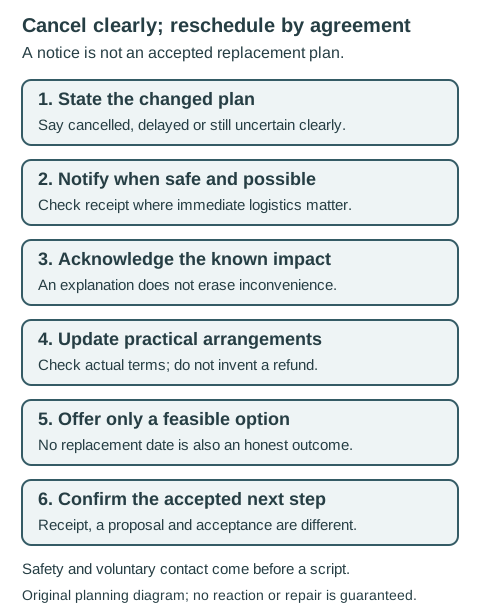
Use only fields that help clarify the plan. The blank file does not collect or assess your answers. A completed record may contain private information; keep it only where appropriate and safe. It is a planning aid, not a contract, safety assessment or validated relationship tool.
Before sending your own message, check that it names the original activity, does not promise an unavailable alternative and leaves room for a real response. Afterward, record what actually happened. “Cancelled, no new date” is a complete honest outcome; do not make the worksheet look successful by inventing agreement.
Six checks for a clear notice and an honest next step
These original cases test the message and arrangement, not another person’s character. Try each answer before opening the explanation.
Case 1
You already know you cannot attend tonight. Your draft says “I may be a little late.” Does it clearly cancel the plan?
Show answer and explanation for case 1
No. State that you cannot attend and identify the original plan.
A delay and a cancellation require different practical responses. Say what has changed, and check immediate arrangements when needed rather than leaving the other person waiting for an arrival that will not happen.
Case 2
The recipient replies “Got your message” after you propose Saturday. Is Saturday automatically agreed?
Show answer and explanation for case 2
No. Receipt of the notice is not acceptance of the alternative.
Ask about the option if appropriate, and confirm the actual accepted date, time and place or channel. Acknowledgement, proposal and agreement belong in separate fields.
Case 3
You do not know your availability next week. Should you promise a Tuesday meeting simply to soften the cancellation?
Show answer and explanation for case 3
No. Offer only a feasible option, or say there is no replacement date yet.
If you can realistically offer a later scheduling update, name it as an update. Do not turn an unknown schedule into a meeting promise or a polite reply into acceptance.
Case 4
The venue has not answered your change request. Can your message say “Everything is refunded”?
Show answer and explanation for case 4
No. Describe the request and what is still unresolved.
Check the real terms and arrangements. A request, a confirmed change and a refund are different events; this guide does not establish an entitlement or decide who bears a cost.
Case 5
Your own double-booking caused a cancellation. Does “I’ll never disappoint you again” give a realistic changed action?
Show answer and explanation for case 5
No. Name a specific action you can follow through on.
For example, check your calendar before agreeing to another date. Acknowledge the disruption without demanding forgiveness or making an unlimited future promise you cannot keep.
Case 6
A person threatens you for declining a meeting. Should you keep explaining until they accept another date?
Show answer and explanation for case 6
No. Prioritize suitable safety support rather than ordinary rescheduling.
Threats or fear of retaliation are outside the voluntary-plan setting. A script cannot assess danger or guarantee cooperation. Respect appropriate contact limits and use relevant confidential local support.
Sources and further reading
- Hailey Magee / Gottman Institute: Setting Boundaries With OthersComplete book excerpt: requests versus own limits, short direct refusals and disclosure appropriate to trusted relationships. Not validation of cancellation scripts.
- Ohio State News: The 6 elements of an effective apology (12 April 2016)University report on two written accounting-job experiments: apology ratings, responsibility, repair and forgiveness-request findings. Not a full reading of the journal paper or a canceled-plan intervention.
- U.S. Office on Women’s Health: Get helpU.S. confidential support routes and device-history caution; a script cannot determine safety or justify contact.