Practical guide
Texting Expectations for Different Schedules: A Conversation Guide
Name when each person is available, distinguish ordinary messages from a real planning deadline, and record only the reply expectations actually accepted. Use six original examples and an editable agreement without turning a delay into proof of someone’s intentions.
Start with the schedule difference and the connection you want
Different work and sleep schedules can create a texting mismatch without either person having agreed on what a reply should mean. Start by naming the specific situation: “I send messages after dinner, when you are already asleep.” Then name the connection you want: “I would like a realistic chance to catch up.” That is more usable than asking someone to prove care through a response time they cannot keep.
A first message could be: “Our free time is different, and I do not want us guessing about replies. Could we talk about when ordinary messages can wait, and how to make a genuinely time-sensitive plan clear?” Choose a moment when the discussion is voluntary and both people have enough attention. You do not have to negotiate the entire arrangement in a tense message thread.
There is no universal number of minutes that demonstrates a healthy relationship. The point is to describe what each person can actually offer, hear the other person’s needs and record what was accepted. A caring response may still be “I cannot promise that during work.” That answer gives you information about a proposal; it does not require you to pretend the mismatch is resolved.
Love is respect’s digital-boundaries guide names texting expectations as something partners can discuss, alongside privacy and other digital choices. Hailey Magee’s Gottman-published book excerpt distinguishes asking for another person’s participation from deciding your own limits. These are public educational sources, not trials validating the original schedules and messages below.
Separate an ordinary message, a planning deadline and immediate danger
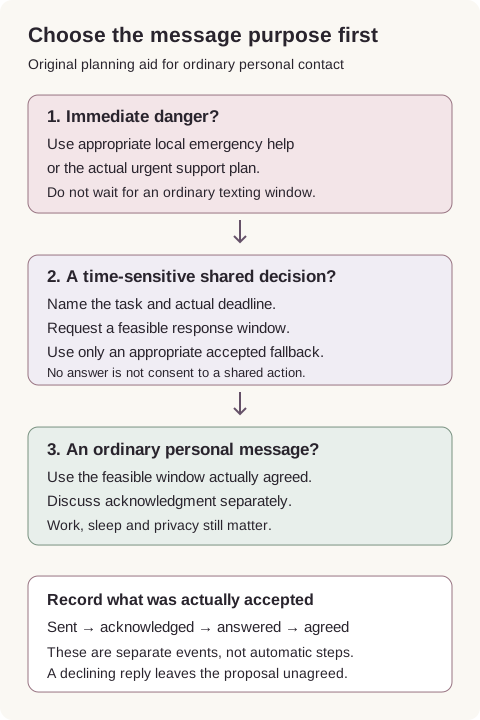
Before choosing a reply time, say what the message is for. A story about your day can wait in a way that an unanswered shared booking decision cannot. An emotional topic can matter deeply without making a partner available at every moment. Name the need rather than using “urgent” to make the other person override work, sleep or a stated contact limit.
| Purpose | Make clear | Keep the limit |
|---|---|---|
| Ordinary personal message | An update, thought or question to read when available. | No immediate response is implied unless actually agreed. |
| Time-sensitive shared decision | The specific decision, external deadline and feasible reply request. | Silence is not permission; define an appropriate practical fallback. |
| A substantive emotional conversation | The topic and a request to arrange attention for it. | A brief acknowledgment is not a completed discussion. |
| Immediate danger or urgent essential care | The actual local emergency or established support route. | Do not rely on an ordinary personal-texting window. |
For a time-sensitive task, include the real deadline: “The booking closes at 5; can you answer by 3 if that is workable?” State what you can appropriately do if no answer comes. “I will not book for both of us without approval” is different from assuming that no reply means yes.
If a child, dependent person or essential care arrangement needs an urgent response, use the actual care and support plan. Confirm that a backup person has accepted their role. This article does not determine which situation is a medical emergency, replace local help or establish that a particular notification will get through.
Build an eight-part agreement without requiring constant access
Use these eight points to identify what is agreed and what remains uncertain. You can keep the conversation short and fill the record later. An unanswered proposal belongs under “not agreed,” even if it sounds reasonable to you.
- Purpose: Name what this arrangement covers: ordinary personal messages, arranging a call or one shared planning task.
- Unavailable periods: Describe work, sleep or care periods at the level you want to share. Availability does not require a location history or private evidence.
- Ordinary reply expectation: Choose a feasible window or a clear uncertainty, such as after a changing shift. A window is not continuous access throughout that period.
- Acknowledgment: Say whether a brief receipt message is wanted, actually accepted and realistic. Keep it separate from a full answer.
- Time-sensitive wording: State the decision, real deadline and action needed. Do not mark an ordinary feeling or disagreement urgent to override a limit.
- Appropriate fallback: Choose a usual accepted contact route or a bounded practical action if no answer arrives. Confirm who can do what; do not assume another person has accepted a backup role.
- Privacy and participation: Keep passwords, private messages and permission to stop contact outside any supposed proof-of-care test. Both people can decline a proposed arrangement.
- Review or change: Choose how to update an unworkable window and when to discuss whether the arrangement still fits. Review the plan, not a surveillance log.
You do not need to give a partner your full work rota, explain private care details or prove your whereabouts to make a limit understandable. Share enough to describe availability, at a level you choose. If a proposed check-in is too frequent or unpredictable, discuss a different form of connection rather than treating the old proposal as compulsory.
Six original message, reply and agreement examples
These fictional examples show different commitments and unresolved questions. The replies are possibilities, not responses you can require. Times and dates are illustrative; adapt them to the actual schedule, your voice and the relationship.
1. Night shift and daytime messages
Opening: “I sleep after my night shift, usually from 8 a.m. to 3 p.m. on workdays. Ordinary messages can wait until I am up. Could we try a short catch-up around 4, when we are both available?”
Possible reply: “That window works for a check-in on your workdays. I will leave ordinary messages for you to read later.”
Honest close: “Agreed: no routine reply expected during my sleep. The 4 p.m. catch-up is an agreed check-in on those workdays, not a promise of an immediate answer to every message.”
Names a sleep period and one accepted connection window. It does not require constant status updates, proof of being asleep or a universal response deadline.
2. A workplace where phones stay away
Opening: “I cannot check personal messages while I am on the floor. I usually look after the shift, but my finish time can change. For everyday messages, please expect a reply when I am available afterward.”
Possible reply: “Okay. If we need a same-day decision, I will say what needs deciding and the real deadline rather than assume you can read it at work.”
Honest close: “We have agreed on the routine expectation. We still need a separate, workable plan for time-sensitive shared arrangements.”
Distinguishes an ordinary reply window from an unresolved practical fallback. Access to a phone, a predictable break and an exact finishing time are not assumed.
3. A booking decision with a real deadline
Opening: “The venue needs our answer by 5 today. Can you confirm whether you want the booking by 3, if that is workable? If I do not hear from you, I will not book for both of us.”
Possible reply: “I can check at lunch and answer by 3. Please do not treat no reply as permission to book for me.”
Honest close: “Agreed: an answer by 3 if you can manage it; without an answer, there is no shared booking approval.”
The message gives the actual external deadline, requests an earlier decision and states a bounded action. It does not turn silence into consent or imply that every personal message is urgent.
4. Two time zones and no shared free evening
Opening: “Our evenings do not overlap this week. Could we exchange ordinary messages when each of us is free, then choose a separate call time? Please include the date and whose local time you mean when offering a call.”
Possible reply: “Asynchronous messages work. I can offer a call on the 12th at 7 p.m. my local time, but we should check the corresponding date and time for you before confirming.”
Honest close: “Ordinary messages do not need a live exchange. The call is still unconfirmed until we check both dates, zones and availability.”
A suggested clock time is not a completed time-zone conversion. Check the actual offset and daylight-saving rules for the date; this example does not calculate them or establish a meeting.
5. Caregiving changes a previously offered window
Opening: “I said I would reply after dinner, but I need to deal with a care task and cannot give this attention now. I can send a scheduling update tomorrow morning; I cannot promise a full conversation then.”
Possible reply: “Thank you for saying what changed. An update is enough; let us arrange the conversation separately.”
Honest close: “The new commitment is a scheduling update, not an appointment to discuss the whole issue.”
Acknowledges the changed offer without disclosing somebody else’s health information. An agreed care or safety obligation needs its actual support plan; a personal-texting arrangement cannot replace one.
6. One person wants a small acknowledgment
Opening: “When I send a longer ordinary message, I sometimes do not know whether it reached you. Would a brief acknowledgment when you next check your phone be workable, even if the full answer comes later?”
Possible reply: “I can sometimes do that after work, but I cannot promise a separate acknowledgment every time. Let us not use it as a daily test.”
Honest close: “A small acknowledgment is an option we can discuss, not an accepted obligation for every message.”
Makes the need visible while keeping the actual response honest. Do not rewrite a partial or conditional offer as an unlimited agreement. A reply can acknowledge receipt without agreeing with the content.
Keep sent, acknowledged, answered and agreed separate
An indicator on a screen cannot answer every relationship question. A delivery or read label reports something according to that platform’s settings; it does not explain someone’s attention, circumstances, intention or willingness to discuss a topic. This guide has not tested any app’s indicators or notification behavior.
| What happened | What you can record | What remains open |
|---|---|---|
| You sent a proposal | The wording and the fact that you sent it. | Receipt and acceptance are still unknown. |
| They acknowledged the message | They said they received or saw it. | The substantive answer may still be pending. |
| They offered to reply later | The actual scope and time they offered. | Whether that offer was accepted or later kept. |
| They accepted a specific arrangement | The agreed window, task or contact route. | Every future circumstance is not guaranteed. |
| They declined an expectation | That this proposal does not work for them. | Whether an alternative can meet both people’s needs. |
If an ordinary message has no answer, avoid inventing a motive or sending a stream of tests. Where a known practical deadline matters, a proportionate follow-up through an appropriate usual channel may be useful. Respect a no-contact limit; do not switch accounts or channels to force access.
If you want comfort after uncertainty, the reassurance guide addresses that separate request. If a misunderstanding has already become tense, the text-repair guide helps separate what was said from what was heard. Neither task is solved by recording a faster response.
Review a changing schedule without building a monitoring system
A useful review asks whether the arrangement fits real life: “Did the after-shift window work, or should we choose a different way to catch up?” Use concrete examples and what each person can offer. A review does not need screenshots of every read receipt, location reports or a tally designed to prove who cares more.
When you offered a window you can no longer keep, acknowledge the change and offer only what is feasible. “I said tonight, but I cannot give this attention; I can send scheduling options tomorrow” is a limited update. It is not permission to claim that a full conversation has now been arranged. The pause-and-return guide is useful when the separate task is resuming a discussion you already paused.
A recurring mismatch may remain unresolved even after clear wording. Name what is still missing: a feasible chance to connect, a kept practical commitment or willingness to discuss the expectation. You can reconsider the arrangement or seek suitable support without diagnosing the other person from message delays. Repeated broken commitments also deserve attention as actions, rather than being explained away by a template.
A boundary about your own participation might be “I will not read ordinary messages while driving or asleep.” A request might be “Could we choose a predictable catch-up time?” Do not turn either into “You must report whenever you are unavailable.” Both people can decline an arrangement; a completed record should not manufacture agreement.
Download the template and choose what is safe to keep
Download the editable texting-expectations agreement. It includes a blank twelve-field record, the six fictional examples and the practice questions with separate answer notes. Write only the details that help clarify your plan.
The file does not submit your answers or assess a relationship. A completed record can contain private information, so store it only where appropriate and safe. If you may be monitored, consider a safer device before looking up support or saving a record. The U.S. Office on Women’s Health warns that an escape button does not erase all browsing history.
Threats, stalking, intimidation or pressure for passwords change the task. Love is respect discusses digital privacy and harassment; a negotiation worksheet cannot make that interaction safe. Use appropriate confidential local support, and relevant local emergency help for immediate danger. The linked Office on Women’s Health support information is for the United States. Elsewhere, choose services that apply to your location. You do not need to prove that you worded a request correctly before seeking help.
Six checks for the message and the actual agreement
Try these checks before opening the answers. They concern wording, evidence and commitments; they do not score a relationship or identify a diagnosis.
Case 1
A partner sleeps after a night shift. An ordinary “How was your day?” message remains unanswered for two hours. Does the delay establish that they are rejecting you?
Show answer and explanation for case 1
No. The unanswered message establishes that you do not yet have an answer. It does not identify a motive. Use the actual agreed availability and discuss a recurring mismatch separately.
Work, sleep, access, attention and an unagreed expectation are different questions. This case is a reading-of-evidence check, not a test of either person’s attachment style.
Case 2
You propose “Let us reply within thirty minutes,” and the other person says that they cannot keep that at work. Is the thirty-minute rule agreed?
Show answer and explanation for case 2
No. It is a declined or unworkable proposal. Ask what is feasible, or recognize that you have not reached a shared arrangement.
The sample interval is not a recommended clinical or etiquette standard. Agreement requires an actual accepted commitment; do not record the proposal as success.
Case 3
Someone replies “Seen; I will answer tomorrow” to your question about a weekend visit. Has the visit been approved?
Show answer and explanation for case 3
No. Receipt and a later-answer plan are different from agreement to the visit. Keep the decision open until it is actually answered.
An acknowledgment can reduce one uncertainty while leaving the substantive question unresolved. It should not be treated as consent to a booking, visit or other shared action.
Case 4
A booking closes at 5. Your message says only “Please reply soon.” What information is missing?
Show answer and explanation for case 4
The decision you need, the real deadline and the proposed action if an answer is unavailable. Make the task clear and request a feasible response window.
If the other person does not answer, use only an action you can appropriately take yourself or an already accepted backup. Silence does not grant permission to commit somebody else.
Case 5
A person demands your passwords and live location to prove that you were too busy to text. Should those demands be added to the schedule template?
Show answer and explanation for case 5
No. A reply-time agreement does not entitle someone to private account access or monitoring. If there is intimidation, stalking or fear of retaliation, choose appropriate confidential support rather than a stronger script.
Love is respect explicitly discusses digital privacy, keeping passwords private and online harassment. This worksheet cannot assess immediate danger or make a controlling interaction suitable for joint negotiation.
Case 6
There is immediate danger and your usual contact has not answered a text. Should you keep waiting for the agreed ordinary reply window?
Show answer and explanation for case 6
No. Use appropriate local emergency assistance or the actual urgent support plan for the situation. An ordinary personal-texting arrangement is not an emergency service.
A partner or friend may be unable to receive, read or act on a message. This guide does not provide emergency dispatch, medical triage or a guarantee of notification delivery.
Sources and further reading
- Love is respect: Digital boundariesDigital communication expectations, mutual changes, privacy and online harassment. Public educational guidance; the original examples here are not tested interventions.
- Hailey Magee / Gottman Institute: Setting Boundaries With OthersComplete published book excerpt distinguishing requests from own limits; not a texting intervention trial.
- U.S. Office on Women’s Health: Get helpU.S. confidential support routes and device-history warning. The worksheet cannot assess danger or replace local emergency help.